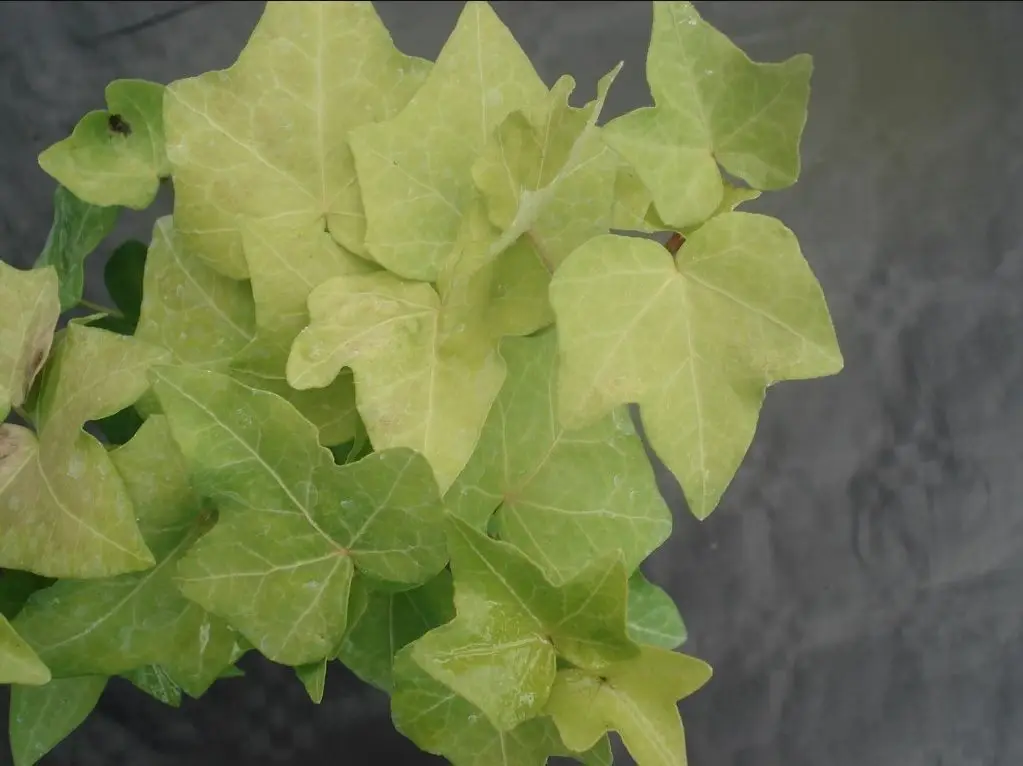
Pretty ivy with yellow to chartreuse-green foliage that turns light green as the leaves age.

Cold conditions can cause red discolouration of the leaves.

Choose a bright spot to keep the foliage beautifully coloured. In such a situation, this charming cultivar will form a dense carpet.

From 5.90 

Clear
Category

Description

Ornamental ivy - Hedera helix ‘Amber Waves’

In a nutshell

Ornamental ivy, Hedera helix ‘Amber Waves’, This pretty ivy has yellow to chartreuse-green foliage that turns light green as the leaves age. The veins remain almost white.

Cold conditions can cause red discolouration of the leaves.

It is best to choose a bright spot to keep the foliage beautifully coloured. In such a situation, this charming cultivar will form a dense carpet. It grows rather slowly. It will look great in small garden spaces.

History

This cultivar was discovered by Russel Windle, Pennsylvania, from a cutting of half-green, half-yellow ivy, which mutated into completely yellow ivy.

Technical details - Hedera helix 'Amber Waves'

Botanical information

  • Family: Araliaceae
  • Genre : Hedera
  • Species : helix
  • Cultivar : ‘Amber Waves’
  • Pierot classification: ivy type
  • Foliage stage: juvenile
  • Origin of the species: Europe, from Spain to Norway, but little on the Atlantic coast.
  • Origin of cultivar: discovered by Russel Windle, Pennsylvania


Description of Hedera helix ‘Amber Waves’

  • Port : compact
  • Number of lobes: 3 to 5 lobes in general, rounded to square
  • Leaf length: 4 cm
  • Sheet width: 4 cm
  • Colour of leaf: yellow to chartreuse green
  • Colour of veins: white to light green
  • Base of leaf: cordate
  • Stems: well-branched
  • Colour of stem and petiole: purple green
  • Hairs: stellate, 3 to 5 branches


Planting, cultivation and maintenance advice for Hedera helix ‘Amber Waves’

  • Exposure: sun, part shade
  • Hardiness: -15°C
  • Soil moisture: cool soil
  • Soil PH: neutral or chalky
  • Soil type: all
  • Soil richness: ordinary or humus-bearing
  • Use: ground cover, hanging baskets, pots, window boxes
  • Development: moderate
  • Pruning: once a year
  • Pests: very rare (spider mites, mealy bugs)
  • Diseases: very rare (leaf spots)

A page from my little ivy encyclopaedia

All your questions about ivy

How should indoor ivy be watered?

Ivy is an excellent indoor plant, with attractive foliage all year round and its qualities as a depolluting plant.

When it comes to watering, the rule is moderation. Water when the surface of the soil is dry to the touch. In general, this means moderate watering once a week. In winter, reduce the frequency of watering, as the plant enters a resting period and uses less water.

Make sure the pot has drainage holes to prevent water build-up, which can cause root rot.

In winter, if the ambient air is very dry because of the heating, mist the leaves regularly or place the pot on a tray of pebbles filled with water to increase the humidity level around the plant.

La boutique du lierre - guirlande de lierre

Ivy in literature

“The ivy that climbs this grave whispers secrets to the dead.

Shakespeare, Hamlet

Additional information

Weight N/A
Stock of 1-litre cups and pots

1 to 2 pots

Stock 2 or 4 litre containers

6 to 10 containers

Large stock items

0 big topic

General appearance

Thick, Tufted

Type of foliage and colour

Yellow, Red in winter

Possible uses

Ground cover, Houseplant, Pots or planters, Hanging lamp

Exhibition

Part shade, Sun

Hardiness

Good hardiness

Easy to grow

Easy

Speed

Slow

Vigorous development

Modest

Classification according to the Pierot system

From 'Pittsburgh', Ivy type

Reward obtained

No known reward

Reviews

There are no reviews yet.

Only logged in customers who have purchased this product may leave a review.

Find out more ...

Other interesting ivy plants for you