
Japanese ivy
Japanese ivy, Hedera rhombea
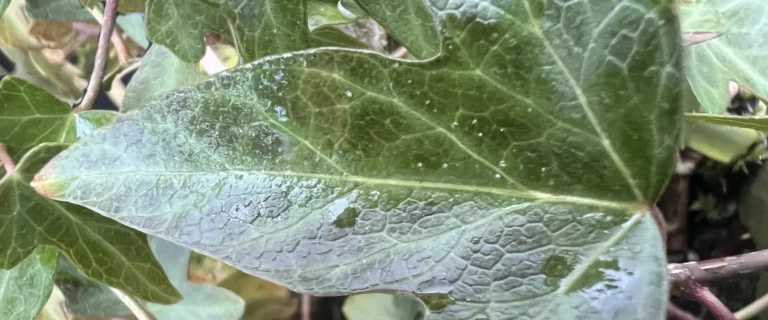
Japanese ivy, Hedera rhombea, It forms fine, delicate matt leaves with soft green or silvery veins.
The overall shape of the leaf is more like a rhombus, hence its name. rhombea.
They generally have 3 to 5 lobes, often shallow. The base is sometimes cordate (heart-shaped), sometimes truncated, sometimes hastate (arrow-shaped). The central lobe is triangular.
It is a creeping or climbing ivy, depending on the opportunity. It is vigorous and can grow up to 10 m long.
When fully grown, Japanese ivy forms flowers in the form of cream-coloured umbels. It flowers in autumn. The fruit that follows are berries, black when ripe.
Ecological interest of Japanese ivy
Like all ivy, Japanese ivy is a boon for biodiversity. This plant provides shelter and food for a wide variety of insects and birds.
Japanese ivy - Origins and variants
As its name suggests, Japanese ivy comes from eastern Asia, mainly Japan, Taiwan and Korea.
Hedera rhombea prefers damp, shady areas such as pine forests or riverbanks.
On the island of Taiwan, there are ivy plants whose juvenile leaves have a large triangular central lobe with an acuminate tip and truncated base. Some botanists refer to it as the Hedera formosana.
In the same way, another species of ivy from this region, with fine peduncles and pedicels, has been given the name of Hedera pedunculata.
But in both cases, the distinguishing features are quite subtle and, above all, there is a continuity of these features in the field. As a result, the most common conclusion reached by botanists is that these different variants should be recognised as a single species: Hedera rhombea.
Advice on planting, growing and caring for Japanese ivy
Ivy is one of the easiest plants to grow in our gardens. It is not demanding in terms of soil type: chalky soil, neutral soil or acidic soil are all suitable (unlike common ivy). Hedera helix). In terms of exposure, it thrives in both shade and sun, although it prefers shade or semi-shade. It is drought-resistant, but will grow best in cool soil. If the soil is good, i.e. sufficiently rich in humus, no fertiliser will be needed.
What are Japanese ivy's uses in the garden?
Ivy can be easily integrated into any garden, small or large. Unlike other perennials or climbers, it has the advantage of staying green and beautiful all year round. Hiding an unsightly wall, forming hedges to protect privacy, covering the ground under trees, including fruit trees, dressing the wall of a facade, lighting up a shady area - almost anything is possible with this type of plant. If you're planning to plant an ivy hedge, you'll need to install a wire mesh to support it. Allow 2 to 3 ivy plants per linear metre.
However, there are a few uses for ivy that are less recommended: avoid placing it in the middle of rose bushes, as it will tend to suffocate them. The combination of bulbs and ivy is not a happy one either. But there are so many other possibilities with this type of plant. Of course, Japanese ivy has an indisputable place in a Japanese garden, by a spring or to cover rocks, for example.
In all cases, plan to prune every year, for example at the end of winter. The aim is to keep the ivy in the area you have set aside for it. Be aware that ivy is a plant that tolerates severe pruning very well, so if you have neglected maintenance for a year or two, you can correct this with a vigorous pruning. Japanese ivy as ground cover offers another significant advantage: weeds are virtually non-existent, as they are smothered by the ivy.
Buy Japanese ivy
We have several cultivars of Japanese ivy in our collection: the widest choice of ivy of any online plant retailer. You'll find all the information you need about plant sizes and prices. We dispatch the plants you order every Monday. Your order will therefore be delivered within a week of placing it. Our stock is both large and limited. We have a large stock of different types of ivy. But we have a limited stock of each type of ivy. However, if you require large quantities of certain products, we can grow the variety you want.
To help you choose the product that's right for you, here are the main characteristics of the Japanese ivy in our collection:
- Hedera rhombea ‘Eastern Dawn’: an ivy with variegated foliage that thrives in sunlight
- Hedera rhombea ‘Pierot’: a miniature ivy with brown-tinted leaves in cold conditions.
- Hedera rhombea semi-arborescent: a shrubby ivy of great aesthetic interest.
- Hedera rhombea ‘Submarginata Arborescens‘A shrubby ivy with marbled leaves.
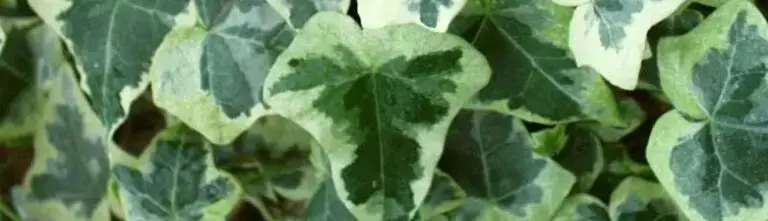
- Hedera rhombea ‘Variegata‘Ivy with white-edged leaves.
Japanese false ivy - we're up in arms!!!
You can find a plant called «Japanese ivy» which is not actually ivy at all. It's a Virginia creeper! See what Wikipedia.
Do a Google search for «Japanese ivy» or «Japanese ivy». What do you find? Only Virginia creeper! Not a word about ivy! And then they say that Google selects the most relevant content! Ivy is ivy and its botanical name is Hedera. The Virginia creeper has never belonged to the ivy family. Its botanical name is Parthenocissus. They're not even from the same family.
But this isn't the first time some people have confused ivy with Virginia creeper. Just look at the photos of ivy on Pixabay or Pinterest, for example. You'll find plenty of photos of Virginia creeper! Of course, they're both climbing plants, but that's about all they have in common.
In this respect, beware of what are known as vernacular names, i.e. the names of plants in everyday language. Of course, it's easier to talk about ivy than Hedera, or cabbage rather than Brassica. Not everyone speaks Latin! Especially these days!
But the same plant can have many different vernacular names, depending on custom or region. Some are correct, but others are confusing. Sometimes even dangerously so. Take laurel, for example. Don't try to use oleander to flavour your sauces. It's a highly toxic plant, and yet it's called laurel, but wrongly so because it's not a plant of the genus Laurus.
So let's get serious and call plants by their proper names. There's only one Japanese ivy, botanically speaking, and that's the Hedera rhombea. Don't be fooled by anyone, including well-known nurseries, offering you Japanese ivy that isn't actually ivy!


 Français
  English (UK)
  Deutsch
  Nederlands
  Italiano


