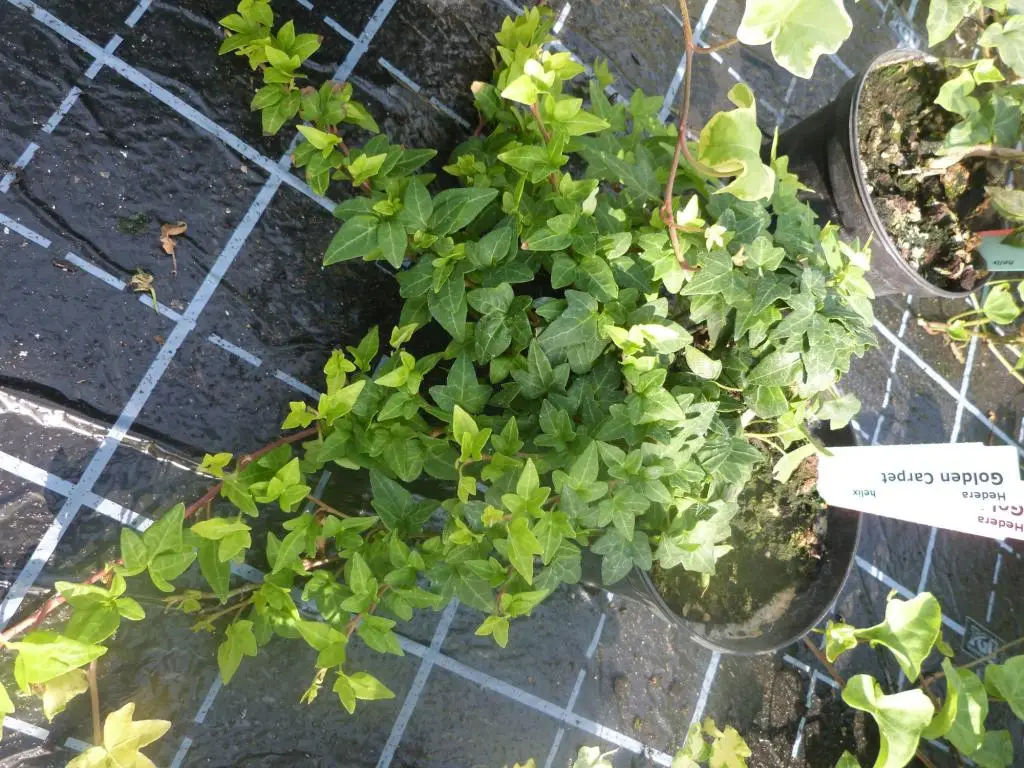
Ornamental ivy that lives up to its name (golden carpet).

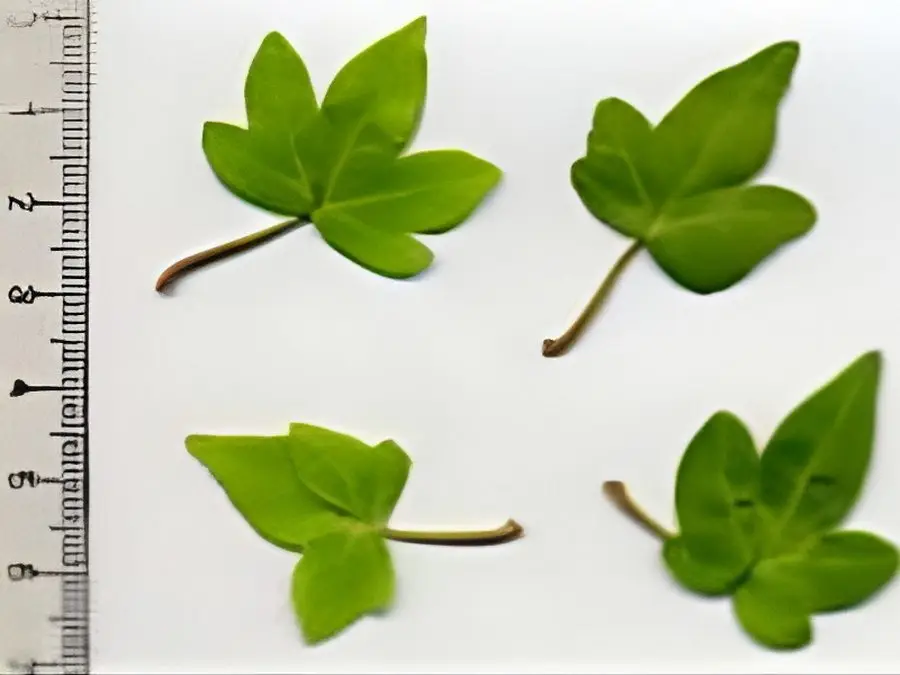
Leaves composed of 3 to 5 slightly blunt lobes with deep sinuses, often overlapping at the base. The median lobe is clearly longer than the lateral lobes. Blade yellow to chartreuse green, becoming light green with age.

Can be used as ground cover, but is also a good climber. Can also be used for topiary.

From 5.90 

Clear
Category

Description

Ornamental ivy - Hedera helix ‘Golden Carpet’

In a nutshell

Ornamental ivy, Hedera helix ‘Golden Carpet’, It lives up to its name (golden carpet).

The leaves are composed of 3 to 5 slightly blunt lobes with deep sinuses. They often overlap at the base. The median lobe is clearly longer than the lateral lobes. The leaf blade is yellow to chartreuse green, becoming light green with age.

It can be used as ground cover, but is also a good climber. It can also be used as a topiary. To keep its bright colours, choose a sunny position.

History

This cultivar, of Danish origin, is the result of a mutation of ‘Shamrock’.

Technical details - Hedera helix 'Golden Carpet'

Botanical information

  • Family: Araliaceae
  • Genre : Hedera
  • Species : helix
  • Cultivar: ‘Golden Carpet’
  • Pierot classification: ivy with bird's-foot leaves
  • Foliage stage: juvenile
  • Origin of the species: Europe, from Spain to Norway, but little on the Atlantic coast.
  • Origin of cultivar: probably of Danish origin, sport of ‘Shamrock’.’


Description of Hedera helix ‘Shamrock’

  • Growth habit: spreading, extensive, compact, stocky
  • Number of lobes: 3 to 5 lobes in general
  • Leaf length: 4 cm
  • Sheet width: 4 cm
  • Colour of leaf: light green
  • Colour of veins: pink and cream
  • Colour of stem and petiole: pink
  • Branches: very branched
  • Hairs: stellate, 3 to 5 branches


Planting, cultivation and maintenance advice for Hedera helix ‘Golden Carpet’

  • Exposure : sun
  • Hardiness: -15°C
  • Soil moisture: cool soil
  • Soil PH: neutral or chalky
  • Soil type: all
  • Soil richness: ordinary or humus-bearing
  • Use: ground cover, climber, pot, window box, hanging baskets, topiary
  • Development: rapid
  • Pruning: once a year
  • Pests: very rare (spider mites, mealy bugs)
  • Diseases: very rare (leaf spots)

A page from my little ivy encyclopaedia

The occasional question ...

What is the sinus of a leaf?

Ivy leaves are usually lobed, i.e. with a more or less divided blade. The number of lobes is generally three to five. The indentation or indentation between each lobe is botanically called the sinus

The sinus can be more or less deep. They may form an obtuse or acute angle, but they may also be more or less rounded. Sometimes they are very shallow, almost flat.

La boutique du lierre - guirlande de lierre

Ivy in literature

The ivy, spreading out its green arms, seemed to embrace the stones with infinite love.

Oscar Wilde, The Canterville Ghost

Additional information

Weight N/A
Stock of 1-litre cups and pots

11 to 20 pots

Stock 2 or 4 litre containers

11 to 20 containers

Large stock items

0 big topic

General appearance

Compact, Spread out, Trapu, Very branched

Type of foliage and colour

Yellow

Possible uses

Ground cover, Climber, Pots or planters, Hanging lamp

Exhibition

Sun

Hardiness

Good hardiness

Easy to grow

Easy

Speed

Fast

Vigorous development

Medium

Classification according to the Pierot system

From 'Pittsburgh', Bird's Paw

Reward obtained

No known reward

Reviews

There are no reviews yet.

Only logged in customers who have purchased this product may leave a review.

Find out more ...

Other interesting ivy plants for you