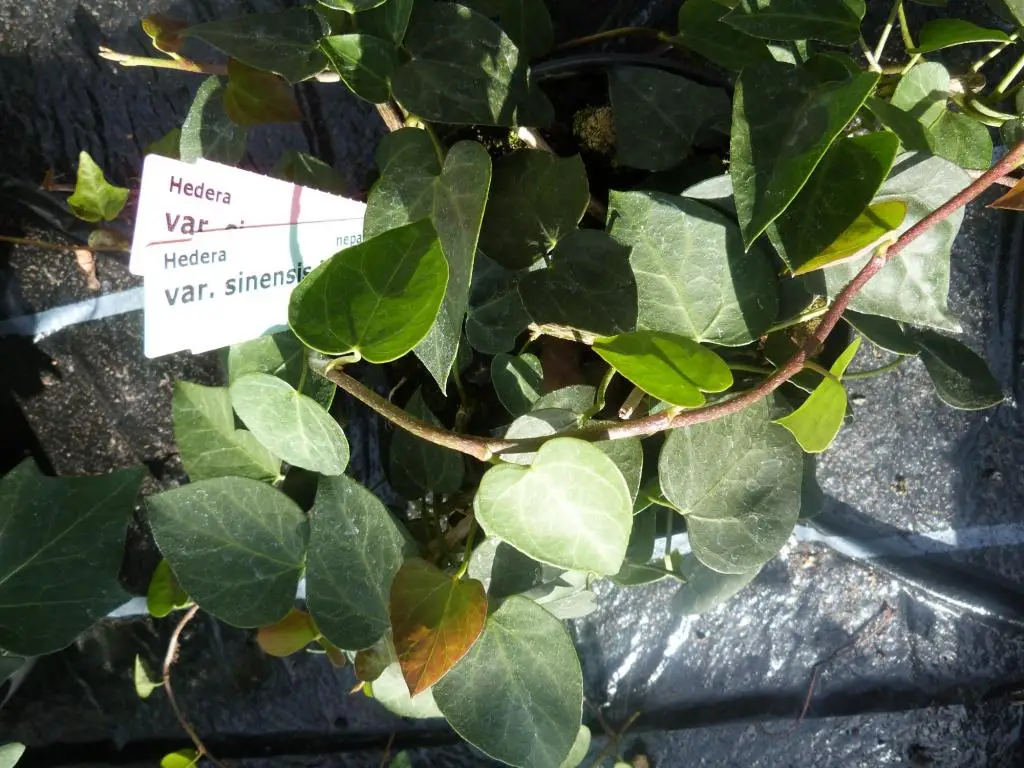
Chinese ivy, variety found in Holland by Olivier Arcelus, small, light green, undented leaves.

Leaves not lobed or sometimes three-lobed, with a wedge-shaped, cordate or truncated base. Blade medium green, criss-crossed with light green veins.

Stems more or less branched, rather slender, purple or green, with internodes 4 to 6 cm apart.

From 6.90 

Clear
Category

Description

Chinese ivy - Hedera nepalensis var. sinensis NL

In a nutshell

Chinese ivy, Hedera nepalensis var. sinensis, The leaves are non-lobed or sometimes three-lobed, with a wedge-shaped, cordate or truncated base.

The leaf blade is medium green, criss-crossed with light green veins. The main vein is purple-black on the inside of the leaf.

The stems are more or less branched, rather slender, purple or green, with internodes 4 to 6 cm apart.

History

The botanical nomenclature of this Chinese ivy, found by Olivier Arcelus in Holland, is not absolutely certain. It is characterised by small, light-green, non-toothed leaves.

Technical leaflet - Hedera nepalensis var. sinensis NL

Botanical information

  • Family: Araliaceae
  • Genre : Hedera
  • Species : nepalensis
  • Subspecies: var. sinensis
  • Pierot classification: heart-shaped ivy
  • Foliage stage: juvenile
  • Origin of the species: China, south-west Asia
  • Origin of cultivar: found in Holland


Description of Hedera nepalensis var. sinensis NL

  • Growth habit: spreading, stocky
  • Number of lobes: 0 to 3 lobes in general
  • Leaf length: 7 to 9 cm
  • Leaf width: 5 to 7 cm
  • Colour of leaf: medium green
  • Colour of veins: light green
  • Colour of stem and petiole: purple or green
  • Hair: scaly, small, but broad in the centre


Advice on planting, cultivation and care of Hedera nepalensis var. sinensis NL

  • Exposure: shade, part shade
  • Hardiness: -13°C
  • Soil moisture: cool soil
  • Soil PH: all
  • Soil type: all
  • Soil richness: ordinary or humus-bearing
  • Use: ground cover, climber
  • Development: moderate
  • Pruning: once a year
  • Pests: very rare (spider mites, mealy bugs)
  • Diseases: very rare (leaf spots)

A page from my little ivy encyclopaedia

The occasional question ...

What does cuneiform mean?

The vocabulary used by botanists to describe plants is very rich. For leaves alone, you can come across dozens of specific terms.

The word ‘wedge-shaped’ is generally applied to the apex (tip) or base of the leaf and means ‘wedge-shaped’. It therefore refers to a leaf whose apex or base forms an angle (obtuse or acute).

Discover all the vocabulary used to describe leaves.

La boutique du lierre - guirlande de lierre

Ivy in literature

“The ivy-covered walls of the church blended into the landscape like a sacred relic.»

John Ruskin, The Stones of Venice

Additional information

Weight N/A
Stock of 1-litre cups and pots

3 to 5 pots

Stock 2 or 4 litre containers

3 to 5 containers

Large stock items

0 big topic

General appearance

Fairly branched, Staggered, Stocky

Type of foliage and colour

Atypical, Red in winter, Green

Possible uses

Climber

Exhibition

Shadow

Hardiness

Fairly hardy

Easy to grow

Average

Speed

Average

Vigorous development

Medium

Classification according to the Pierot system

Heart-shaped

Reward obtained

No known reward

Reviews

There are no reviews yet.

Only logged in customers who have purchased this product may leave a review.

Find out more ...

Other interesting ivy plants for you