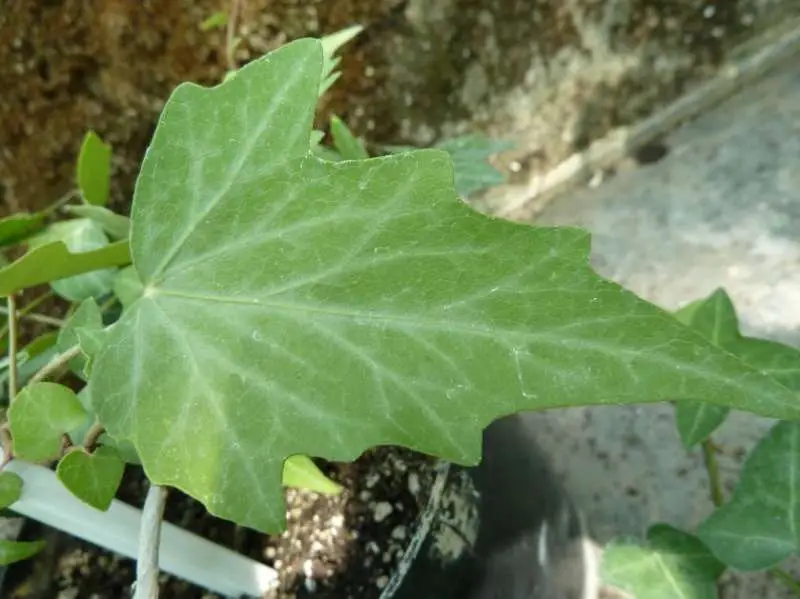
Leaves with 3 or 5 main lobes, themselves composed of mini-lobes.

Blade medium green, criss-crossed with light green to greyish veins. >Main vein purple-black on the inside of the leaf. Stems more or less branched, rather thin, purple or green, with internodes 4 to 6 cm apart.

A good climber and interesting ground cover, it should be planted in the shade. Although resistant to dry conditions, it prefers cool areas.

From 6.90 

Clear
Category

Description

Chinese ivy - Hedera nepalensis var. sinensis

In a nutshell

Chinese ivy, Hedera nepalensis var. sinensis, It has leaves with 3 or 5 main lobes, themselves made up of mini-lobes.

The leaf blade is medium green, criss-crossed with light green to greyish veins. The main vein is purple-black on the inside of the leaf. The stems are more or less branched, rather slender, purple or green, with internodes 4 to 6 cm apart.

A good climber, it is also an interesting ground cover plant. It should be planted in the shade. Although resistant to dry conditions, it prefers cool areas.

Technical details - Hedera nepalensis var. sinensis

Botanical information

  • Family: Araliaceae
  • Genre : Hedera
  • Species : nepalensis
  • Subspecies: var. sinensis
  • Pierot classification: heart-shaped ivy
  • Foliage stage: juvenile
  • Origin of the species: China, south-west Asia


Description of Hedera nepalensis var. sinensis

  • Growth habit: spreading, stocky
  • Number of lobes: 3 to 5 lobes in general, plus mini lobes
  • Leaf length: 7 to 9 cm
  • Leaf width: 5 to 7 cm
  • Colour of leaf: medium green
  • Colour of veins: light green to greyish
  • Colour of stem and petiole: purple or green
  • Fructification: shiny orange fruits, 1 cm in diameter
  • Hair: scaly, small, but broad in the centre


Advice on planting, growing and caring for Hedera nepalensis var. sinensis

  • Exposure: shade
  • Hardiness: -13°C
  • Soil moisture: cool soil
  • Soil PH: all
  • Soil type: all
  • Soil richness: ordinary or humus-bearing
  • Use: ground cover, climber
  • Development: moderate
  • Pruning: once a year
  • Pests: very rare (spider mites, mealy bugs)
  • Diseases: very rare (leaf spots)

A page from my little ivy encyclopaedia

  • All your questions about ivy

Nepal ivy, Himalayan ivy, Chinese ivy - what are the differences?

They are all part of the species Hedera nepalensis. But some botanists distinguish two subspecies within the species Hedera nepalensis :

  • Hedera nepalensis var. nepalensis, found mainly from Nepal to Kashmir and also known as Nepal ivy or Himalayan ivy.
  • Hedera nepalensis var. sinensis, which comes from south-west China and is known as Chinese ivy.

Apart from the difference in geographical origin, the distinction is not obvious, as there is great variability in the shape of the leaves of this species in each region. This is why other botanists do not use these subspecies.

Perhaps most importantly, what differentiates Hedera nepalensis of other ivy species are the following 3 characteristics:

  • greyish veins on the leaves
  • small, reddish, scaly hairs
  • orange fruits.
La boutique du lierre - guirlande de lierre

Ivy in literature

“The ivy wrapped around the stones like an embrace of nature on what was once alive.

Charlotte Brontë, Villette

Additional information

Weight N/A
Stock of 1-litre cups and pots

21 to 50 pots

Stock 2 or 4 litre containers

0 container

Large stock items

3 to 5 large subjects

General appearance

Fairly branched, Staggered, Stocky

Type of foliage and colour

Atypical, Red in winter, Green

Possible uses

Climber

Exhibition

Shadow

Hardiness

Fairly hardy

Easy to grow

Average

Speed

Average

Vigorous development

Medium

Classification according to the Pierot system

Heart-shaped

Reward obtained

No known reward

Reviews

There are no reviews yet.

Only logged in customers who have purchased this product may leave a review.

Find out more ...

Other interesting ivy plants for you