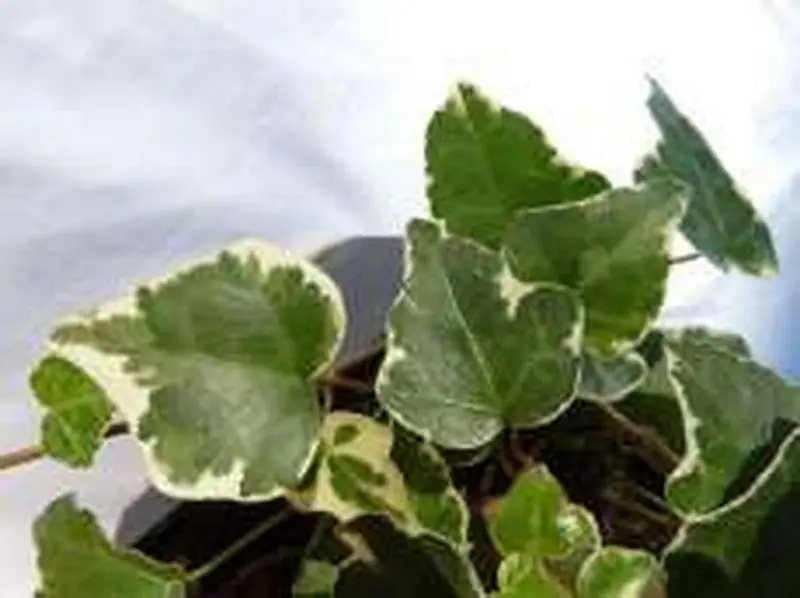
Small triangular or three-lobed leaves, greyish green in the centre, narrowly edged with white. Rounded lobes.

In winter, the white border turns pink. The petioles and stems become wine-red.

An interesting ivy, particularly for rock gardens.

From 6.90 

Clear
Category

Description

Japanese ivy - Hedera rhombea ‘Variegata’ (Variegated)’

In a nutshell

Japanese ivy, Hedera rhombea ‘Variegata’, The leaves are small, triangular or three-lobed. The lobes, where they exist, are rounded. The leaf blade is greyish-green in the centre and narrowly edged with white.

In winter, the white border turns pink. The petioles and stems become wine-red.

This ivy was brought from Japan around 1860 and introduced to Belgium. It was first described in ‘Belgium Horticulture‘in 1865.

It can be used in rock gardens in particular.

History

The origin of this cultivar is not known.

Technical details - Japanese ivy 'Variegata'

Botanical information

  • Family: Araliaceae
  • Genre : Hedera
  • Species : rhombea
  • Cultivar: ‘Variegata’
  • Pierot classification: heart-shaped ivy, variegated ivy
  • Foliage stage: juvenile
  • Origin of the species: East Asia
  • Origin of cultivar: unknown


Description of Hedera rhombea ‘Variegata’

  • Growth habit: spreading, sparse
  • Number of lobes: 0 to 3 lobes in general
  • Leaf length: 3 cm
  • Sheet width: 3 cm
  • Colour of leaf: greyish green with white margins
  • Colour variations: pink-tinted border in winter
  • Colour of veins: cream
  • Stems: thin
  • Colour of stem and petiole: pinkish green, turning wine-red in winter
  • Hairs: scaly, 10 to 18 branches


Planting, growing and care instructions for Hedera rhombea ‘Variegata’

  • Exposure: sun, part shade
  • Hardiness: -12°C
  • Soil moisture: cool soil
  • Soil PH: all
  • Soil type: all
  • Soil richness: ordinary or humus-bearing
  • Use: ground cover, pots, window boxes, rockery
  • Development: moderate
  • Pruning: once a year
  • Pests: very rare (spider mites, mealy bugs)
  • Diseases: very rare (leaf spots),

A page from my little ivy encyclopaedia

All your questions about ivy

Can ivy attract insects or pests?

Ivy provides shelter for a wide variety of wildlife, including insects, birds and small mammals. These may include undesirables, but also many useful species.   

Aphids, mealybugs and ladybird beetles can all be found there. When it flowers in late summer or autumn, it attracts large numbers of pollinators, such as butterflies and bees. Ivy honey is highly prized.

Many birds love ivy. They can nest there and find food. These include blackbirds, thrushes, sparrows, robins, house wrens, black-headed warblers, pigeons and more.

Some small mammals can make their home here, including hedgehogs, shrews, mice, field mice, bats, squirrels and dormice.

A natural balance is created in this lively space.                                      

La boutique du lierre - Ivy garland

Ivy in literature

“Ivy clings where the wind blows, feeding on ruins like fertile soil.

George Eliot, Silas Marner

Additional information

Weight N/A
Stock of 1-litre cups and pots

21 to 50 pots

Stock 2 or 4 litre containers

0 container

Large stock items

0 big topic

General appearance

Fairly branched, Scattered, Spread out

Type of foliage and colour

Mixed white

Possible uses

Ground cover, Pots or planters, Rockwork

Exhibition

Part shade, Sun

Hardiness

Fairly hardy

Easy to grow

Average

Speed

Average

Vigorous development

Medium

Classification according to the Pierot system

Heart-shaped

Reward obtained

No known reward

Reviews

There are no reviews yet.

Only logged in customers who have purchased this product may leave a review.

Find out more ...

Other interesting ivy plants for you