
Ivy, a plant for the future
Table of contents
Who's right? Should the ivy be uprooted or planted?
Ivy, from its botanical name Hedera, is a particularly divisive plant. Some people do everything they can to get rid of it, accusing it of all sorts of evils, while others praise it with force and conviction.
Yet the debate is simple to settle. The former rely on often unfounded reputations, which we will examine as objectively as possible. As for the latter, they note that ivy ticks all the boxes of the plants that are in demand these days.
The criticisms heard:
1 - Ivy is toxic Yes, its berries are toxic to humans and certain animals, although they were sometimes used boiled as food during the Second World War. But these same berries are appreciated by birds, particularly at the end of winter. Ivy is also regularly used as a medicinal plant, notably to treat coughs, respiratory problems and certain skin diseases. As is often the case with certain substances, it's the dose that makes the poison.
1 - Ivy is invasive This is partly true. Neglected ivy can spread to the detriment of other plants, or climb onto the roof and slip under the tiles. But ivy is a plant that tolerates pruning perfectly well. In fact, pruning is virtually the only maintenance it requires, and once a year is usually more than enough. What's more, there are many varieties of ivy that remain compact and low-growing. With these, there is virtually no risk of overgrowth.
2 - Ivy damages walls This is usually not true. First of all, ivy does not damage walls in good condition. On the contrary, it protects the wall from damp, which preserves it. Similarly, an old stone wall will not be damaged by ivy. It's the removal of the ivy that could actually cause the stones to fall out. But if you leave it alone, the ivy will form a woody carapace that will strengthen the old wall. On the other hand, if the wall is cracked, the ivy can penetrate the cracks in the wall and accentuate the phenomenon. So you can safely install ivy at the foot of a healthy wall.
3 - Ivy is a parasite It's totally false. Every botanist will tell you so. Ivy uses spikes to attach itself, but these are not used to pump sap. What's more, ivy roots do not compete with tree roots at the foot of a tree. On the contrary, ivy, whose dry leaves decompose on the spot, will provide humus for the trees and protect the soil. What's more, when ivy climbs trees, it does so vertically without strangling the tree, unlike other climbers. Ivy will usually stop well before the canopy and will not deprive the tree of light. Only trees at the end of their life may be completely covered by ivy. But it is not the ivy that causes the tree to end its life. So most of the time, you're doing something useful by planting ivy at the foot of your trees.

In search of the ideal plant.
Now that we've been reassured about the supposed dangers of ivy, let's see if it can meet today's criteria in the search for the ideal plant. In today's world, the plants most sought-after are often those that :
- require little maintenance
- are beautiful all the time
- drought-resistant
- cold-resistant
- suitable for all types of terrain
- tolerate all exposures
- are good for the environment
- are useful for biodiversity
- ...
Let's get to know ivy
Ivy is a member of the Araliaceae family.
Curiously, among the forty or so botanical genera in this family, the, Hedera is the only representative of this family in the European flora. All the other members of this family are tropical or sub-tropical plants. Ivy is therefore the only member of the family in the temperate zone. In fact, it is thought to have appeared on earth towards the end of the secondary era. It is therefore a very old plant. At that time, it was found in regions with a much warmer climate than today. At that time, many plants flowered and produced fruit in winter, a more favourable season because it was more temperate and wetter. Since then, there have been many major climatic changes, and many of the plants and animals of that time have disappeared. Only those able to adapt have survived. Ivy is one of them, a testament to its resilience. Ivy has retained its seasonality from the original era, flowering and bearing fruit from October to March.
Ivy can live a very long life, It's certainly more than 400 years old. Some would even say up to 1000 years. When you plant ivy, it's like planting a tree!
It can take considerable dimensions. Ivy can grow to over 30 metres in height. Its stems lignify over time and can be up to 40 cm in diameter.
The 3 ages of ivy
Ivy goes through 3 successive stages. First, it crawls and spreads out. Its stems emit adventitious roots that penetrate the soil and strengthen it. It will continue to crawl until it finds support to climb. It then begins its second stage. Instead of adventitious roots, spikes appear, which are not used to feed it but to attach it firmly to its support, a tree, a wall, a post, etc. Its objective now is to seek more light. When it reaches a sufficient height and has enough light, it enters its third stage, the adult stage. Until then, during the previous two stages, ivy was in its juvenile stage. From the adult stage, ivy seeks to reproduce. To do this, it begins to flower and bear fruit.
These three stages are wonderfully told by issues 106 and 107 of La Hulotte magazine which are still available.
Here's a short extract to whet your appetite.


Its leaves
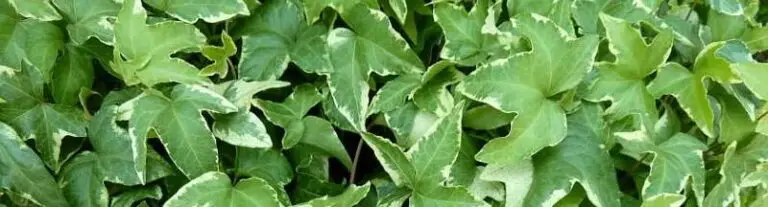
Ivy leaves are evergreen, with 3, 5 or 7 lobes when young. Although they are called «evergreen», they are not eternal. They can live for 3 to 5 years. They are regularly replaced by new leaves, giving ivy its evergreen appearance throughout the 4 seasons. These leaves are criss-crossed with clearly visible veins.
When ivy reaches the adult stage, the stems begin to form branches that spread away from the support. The adult leaves are no longer lobed, but whole, often elliptical or oval. The veins now fade.
So, on the same ivy plant that has reached the adult stage, you will find two leaf forms: juvenile leaves on the lower parts and adult leaves on the shrubby parts. There are often even intermediate forms. Botanists refer to this change in vegetative form as a dimorphism.
An example of a juvenile leaf

An example of an adult leaf
Flowers, fruit, seeds
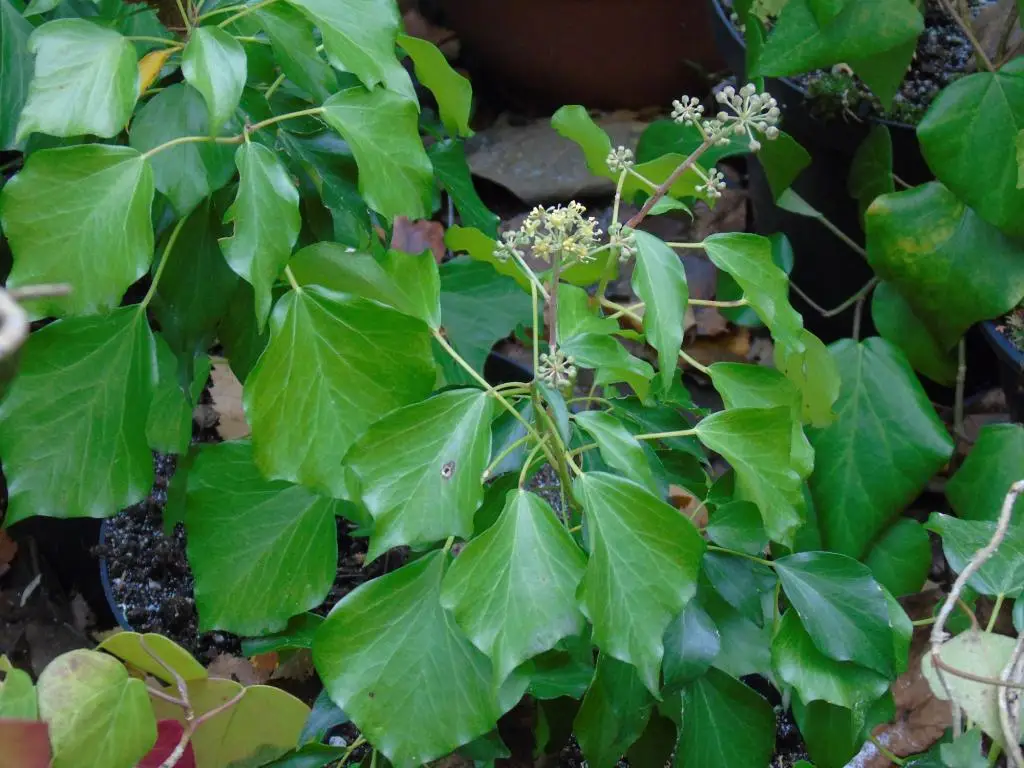
It is only when it has reached the adult stage that ivy begins to produce flowers. These take the form of spherical, greenish-yellow umbels. The flowers themselves are tiny, consisting of 5 sepals, 5 petals and 5 stamens. Flowering generally begins in September and lasts until November.
The fruits are berries that gradually turn from green to black or yellow, depending on the species. They do not ripen until around March. These fruits contain 1 to 5 kidney-shaped seeds.

Ivy hairs
They are barely visible and of no aesthetic interest. But the reason we mention them is that they are of the utmost importance in identifying species. In fact, they are one of the major criteria for differentiation, when other aspects do not allow us to decide on the species. These hairs are found on young shoots and leaf petioles. They are also found on the leaves themselves, particularly on the underside, around the vein. These hairs measure around 0.05 mm. The hairs usually disappear on mature leaves.
Without going into too much detail, there are two types: hairs with a stellate structure, i.e. like a star, and hairs with a scaly structure, in the shape of juxtaposed scales. It is the shape and number of branches that differentiates the species.
The great diversity of ivy
Botanical species
The genre Hedera is made up of around fifteen species, each with its own preferred geographical area, although there are overlaps at the edges:
- Algerian ivy, Hedera algeriensis Hibberd, mainly in Algeria.
- Azores ivy, Hedera azorica Carrière, endemic to the Azores.
- Canary ivy, Hedera canariensis Willdenow, originally from the Canary Islands.
- Colchis ivy, Hedera colchica K. Koch, from the Caucasus region and western Asia.
- Cyprus ivy, Hedera cypria Mc Allister, endemic to Cyprus.
- English ivy, or wood ivy, or common ivy, Hedera helix Linnaeus, which comes from a wide area covering almost all of Europe and western Asia.
- poets' ivy, Hedera helix f. poetarum, a subspecies of English ivy, mainly native to the Caucasus.
- Irish ivy, Hedera hibernica Bean, Ireland and the Atlantic coast of Europe.
- Spanish ivy, Hedera iberica Ackerfield and J. Wen, Spain and Portugal.
- Madeira ivy, Hedera maderensis K. Koch, Madeira archipelago.
- Moroccan ivy, Hedera maroccana Mc Allister, originally from Morocco.
- Nepal ivy, Hedera nepalensis var. nepalensis K. Koch , Nepal, West Asia, India and Indochina.
- Chinese ivy, Hedera nepalensis var. sinensis Rehder, China, Indochina and India.
- Iran ivy, Hedera pastuchovii G. Woronow, Iran, Caucasus and West Asia.
- Japanese ivy, Hedera rhombea Bean, Japan, East Asia.
Each of these species will be described in more detail on the relevant page of this site.
Hybrid species
Four natural hybrids are usually cited. These are :
- Hedera x cazoriensis, hybrid of Hedera helix and Hedera maroccana, spotted in southern Spain by Mc Allister.
- Hedera x nessensis, hybrid of Hedera iberica and Hedera hibernica, found by the same Mc Allister in Monchique, Portugal.
- Hedera x sepulcralis, hybrid of Hedera hibernica and Hedera algeriensis, spotted in a collection near Monterey in California.
- Hedera x soroksariensis, hybrid of Hedera helix and Hedera hibernica, found in a coastal forest in Washington state.
We should also mention an intergeneric hybrid (between two different botanical genera): x Fatshedera lizei, a hybrid between Fatsia japonica ‘Moseri’ and Hedera hibernica. This hybrid itself comes in several cultivars.
Cultivars
There are a large number of cultivars, mainly from Hedera helix, But that's not all. It's difficult to give an exact number, because new ones are being created all the time, some may have disappeared, others are duplicates under different names. But there are certainly more than 500 and probably closer to a thousand.
They come in variegated yellow, cream and white. There are also plants with highly dissected leaves, or curly or wavy leaves. Some are very compact, while others are very voluble. Some prefer the sun, while others are happier in the shade. Some prefer to crawl, while others love to climb. Some will change the colour of their foliage with the seasons. In short, there is a huge diversity of ivy. This site is proof of that.
Ivy has many uses
A beautiful plant all year round
One of the great things about ivy is its decorative evergreen foliage. With ivy, you can be sure of having a plant that will remain beautiful throughout the 4 seasons. This doesn't mean that the landscape will remain identical and monotonous. After all, many varieties offer us changing colours throughout the seasons.
For example, Hedera colchica ‘My Heart’ turns blood red in the cold. Or else, Hedera helix ‘Baccifer’ develops golden young shoots in spring. These are just a few of many examples.
An outstanding ground cover
Everyone knows the ground-cover qualities of ivy and has often seen it demonstrated. This ground cover can be more or less thick and dense depending on the variety. With the densest varieties, weeds have no chance of proliferating. What's more, the usefulness of ground cover in protecting our soil is well established. Ground cover limits erosion and leaching. What's more, the renewal of ivy leaves over the years provides good quality humus that benefits neighbouring trees.
A substitute for grass
In shady areas, and even more so under trees, it is very difficult, if not impossible, to install and maintain a beautiful lawn. Ivy is the ideal answer for these situations. It's not afraid of shade, even dense shade, and it's not afraid of tree roots either. What's more, ivy requires much less maintenance than a lawn, with no need for regular mowing or watering. Once well established, ivy will take care of itself. A simple pruning once a year will suffice to limit it to its own area.
To dress up a façade or hide an unsightly wall
With its spikes, ivy will enjoy climbing up a wall and covering it completely. Facades covered in ivy can be very attractive. However, regular pruning is needed to limit its height and prevent it from climbing onto the roof, as well as to clear openings. When it comes to unsightly walls, ivy is certainly the most effective solution, with a little patience, of course, to allow the ivy to cover the whole area. But be aware that in the latter case, pruning may need to be more frequent.
To dress up an arch or pergola
Another use of the climbing talents of ivy. Plant gates or arches are often the best way to structure the space in a garden. Standard commercial structures are practical, but not always aesthetically pleasing. However, they can be used as a support for an ivy covering. Place an ivy plant on each side of the arch and let them meet at the top. To keep them looking good, plan to prune them regularly. In the same way, you can place ivy plants at the foot of each post of a pergola. As well as looking good, you'll also benefit from the shade effect once the ivy has grown sufficiently.


Ivy in topiary
Ivy can itself be worked as a work of art, in the style of topiary, in the same way as boxwood. Choose varieties with fairly small leaves and dense foliage. A wire-mesh structure is an excellent support. It will soon be completely covered if you choose a fast-growing ivy. Note that this type of topiary, unlike boxwood, is not subject to attack by pests, such as moths, or fungi.
The more often you prune, the more likely your topiary will retain its desired shape and the denser the ivy will grow.
To highlight an object
To show off an object, a statue or a sculpture, you sometimes need a background that makes the work stand out. Ivy lends itself well to this kind of exercise. Choose your shade carefully. Dark green foliage will make light objects stand out. Conversely, ivy foliage in bright shades will enhance darker objects.

Ivy, the house plant
Ivy has long been used as a houseplant. Their ability to thrive in shady or low-light areas makes them particularly well-suited to our interiors. You can grow them in pots or window boxes. If you want to climb them, they will need a support. But you can also let them cascade: ivy is particularly suited to this. With ivy, you can create an easy-to-maintain indoor plant jungle. Choose varieties with particularly decorative foliage. Ivy ‘Glory of Marengo‘is one of the most successful. But if you want more originality, take advantage of the wide choice on this site.
To protect tree trunks
Landscapers and local authorities are starting to plant ivy at the foot of trees to protect their trunks. By covering tree trunks, ivy provides a protective sheath that is beneficial in several ways. It insulates them from the scorching cold and scorching sun to which young trees can be susceptible. In addition, trees whose trunks are surrounded by ivy will not be browsed by animals. As we have already said, ivy is not a parasite. It does not grow to the detriment of trees, quite the contrary, and can provide ground cover that is appreciated by tree roots.

Dressing a dead tree
Dead trees are of great ecological interest. But they are not always aesthetically pleasing in the landscape. One solution is to plant several ivy plants at the foot of the dead tree. Over time, the tree will regain its green appearance. Be aware, however, that with this ivy covering, your dead tree will be more vulnerable to the wind.
To create a green screen
There are many solutions and materials available to isolate you from a neighbour that's a little too present, to conceal an unsightly perspective or simply to create a more intimate corner. Not all of them are durable or tasteful. Have you thought about ivy? To create a plant screen with ivy, all you have to do is provide it with a mesh on which it can settle. There are fast-growing varieties of ivy that can provide a permanent, visually pleasing screen. Ivy lends itself particularly well to pruning, even severe pruning if necessary. You can therefore shape your plant screen as you wish.
To regulate temperatures
Covering walls with ivy has more than just aesthetic appeal. Ivy can be used to insulate and save a few degrees of temperature. It works both ways. It keeps your home cooler in summer, reducing air-conditioning costs. And it protects against the cold in winter, reducing heating costs. Studies on this subject on several public buildings in Great Britain have shown a reduction in air-conditioning costs of 25% on average. Another study in China produced similar results (a reduction of 28%). It should be added that ivy, like all vegetation, reduces outside temperatures, particularly in cities, and helps to purify the air. What's more, managing an ivy-covered wall is much simpler and less costly than plant walls. Urban architects could take inspiration from this.
To promote biodiversity
Ivy, whether on the ground or on a vertical support, is a wonderful shelter for many insects and/or birds. Ivy provides them with shelter and food. Ecologists are well aware of this, and recommend installing ivy to encourage biodiversity. It flowers at the wrong time to other plants, providing nectar that is particularly appreciated by foragers at the end of the season. All you have to do is stand next to a flowering ivy plant on a sunny day to hear the intense buzzing of this highly diverse army of foragers.
Feeding birds in winter
As mentioned above, ivy berries ripen at the end of winter (February-March). This is a time when food for birds is scarce. These berries are therefore very popular at this time of year. Ivy berries are not toxic to birds, which enjoy them when they are ripe. The birds then disperse the seeds in their droppings.

And much more besides ...
These are just a few examples of what you can do with ivy, and of its aesthetic, environmental and ecological benefits. So, without hesitation, plant ivy, plant ivy! It's undoubtedly a plant of the future.


 Français
  English (UK)
  Deutsch
  Nederlands
  Italiano


