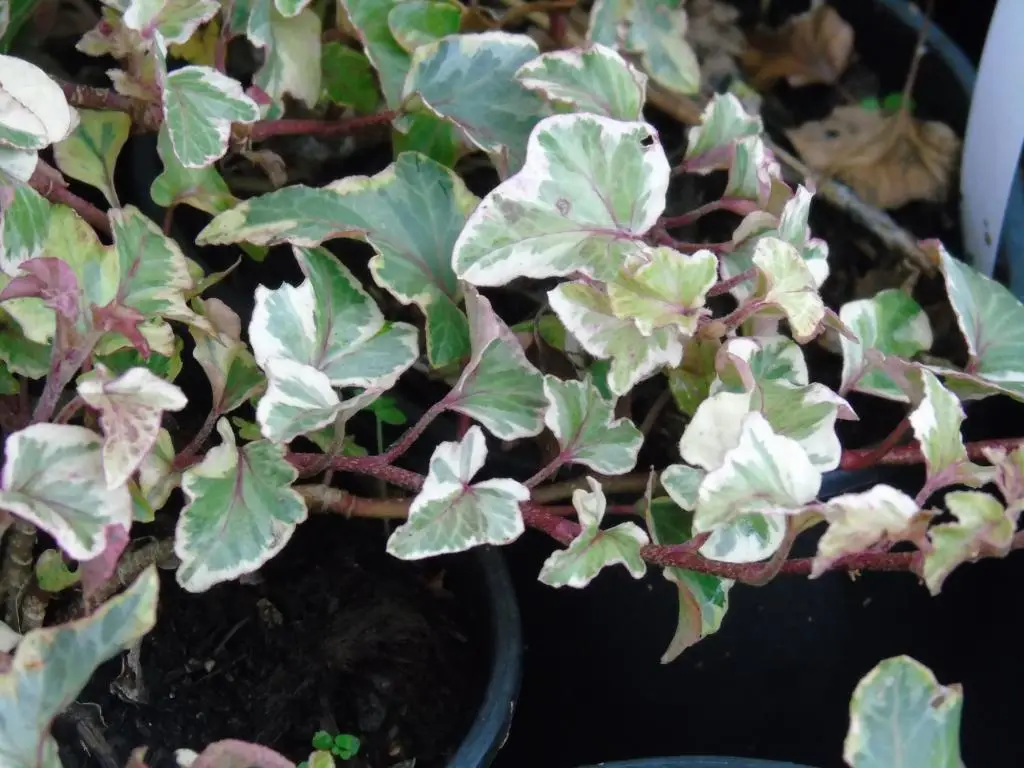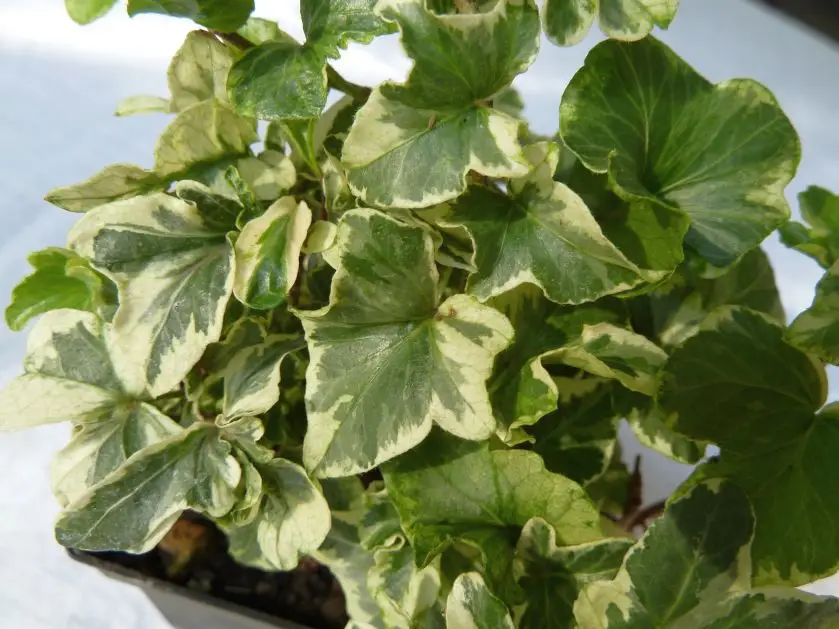
A pretty cultivar with unusual foliage and a compact appearance.

Foliage is curled, wavy and splashed with green spots on a creamy white background. Blade composed of 5 shallow lobes. Edges of lobes rounded. Sometimes a touch of pink.

Slow-growing ivy with short internodes. Forms attractive carpets.

From 5.90 

Clear
Category

Description

Ornamental ivy - Hedera helix ‘Sea Breeze’

In a nutshell

Ornamental ivy, Hedera helix ‘Sea Breeze’, is a pretty cultivar with unusual foliage and a compact appearance.

The foliage is curled, wavy and splashed with green spots on a creamy white background. The leaf blade has 5 shallow lobes. The edges of the lobes are rounded. A touch of pink sometimes adds to the show.

It is a slow-growing ivy with short internodes. All this contributes to the formation of attractive carpets.

History

This cultivar of unknown origin was introduced into cultivation in California, USA, in the 1990s.

Technical details - Hedera helix 'Sea Breeze'

Botanical information

  • Family: Araliaceae
  • Genus Hedera
  • Species : helix
  • Cultivar: ‘Sea Breeze’
  • Pierot classification: ivy with wavy curly leaves, variegated ivy
  • Foliage stage: juvenile
  • Origin of the species: Europe, from Spain to Norway, but little on the Atlantic coast.
  • Origin of cultivar: unknown


Description of Hedera helix ‘Sea Breeze’

  • Port : stocky
  • Number of lobes: 0 to 5 lobes in general
  • Leaf length: 4 cm
  • Sheet width: 3 cm
  • Leaf colour: green and grey-green, creamy white on the margins
  • Leaf shape: very wavy leaf edges
  • Internodes: short
  • Colour of veins: pink and cream
  • Colour of stem and petiole: pink to red
  • Hairs: stellate, 3 to 5 branches


Planting, cultivation and care instructions for Hedera helix ‘Sea Breeze’

  • Exposure: part shade
  • Hardiness: -15°C
  • Growing : easy
  • Soil moisture: cool soil
  • Soil PH: neutral or chalky
  • Soil type: all
  • Soil richness: ordinary or humus-bearing
  • Use: ground cover, pot or window box, hanging baskets, houseplant
  • Development: slow
  • Pruning: once a year
  • Pests: very rare (spider mites, mealy bugs)
  • Diseases: very rare (leaf spots)

A page from my little ivy encyclopaedia

A new look at ivy ...

Is ivy drought-resistant?

Ivy is a very resilient plant, capable of withstanding the worst attacks. Those who have tried to eradicate it have realised this. It could live up to 4,000 years!

As a result, some ivy plants have experienced long periods of drought without disappearing.

With water shortages and watering restrictions looming, ivy is a tried and tested solution. Even if some of its leaves are allowed to dry out, ivy will regenerate quickly when the rain returns.

What's more, by forming a protective mulch over the soil, it also helps other plants to cope better with periods of drought.

La boutique du lierre - Ivy garland

Ivy in literature

“The ivy embraced the hundred-year-old trees, like a lost son finding his family.»

Jean Giono, Le Chant du monde

Additional information

Weight N/A
Stock of 1-litre cups and pots

1 to 2 pots

Stock 2 or 4 litre containers

11 to 20 containers

Large stock items

0 big topic

General appearance

Ramified, Compact, Staggered, Stocky

Type of foliage and colour

Atypical, Curly or wavy, Variegated white

Possible uses

Ground cover, Houseplant, Pots or planters, Hanging lamp

Exhibition

Semi-shade

Hardiness

Good hardiness

Easy to grow

Easy

Speed

Slow

Vigorous development

Modest

Classification according to the Pierot system

Curiosity, Sired by 'Pittsburgh', Wavy, curly or crisp, Mixed

Reward obtained

No known reward

Reviews

There are no reviews yet.

Only logged in customers who have purchased this product may leave a review.

Find out more ...

Other interesting ivy plants for you